By a senior IT consultant with 27 years across Australian enterprise, finance, and government work
Twenty-seven years ago this March, I started my first consulting job. The client ran a small printing business out of Parramatta. Beige Compaq tower under reception. Lotus Notes. A fax machine that wouldn’t quit.
Their question that day was whether they needed a website at all.
Different decade. Same question, dressed up new. These days it’s: which kind of IT consultant do I actually need, and how do I stop wasting money on the wrong one?
Fair question. Wrong one to ask without a map.
The industry has splintered into roughly a dozen specialisations. Pick the wrong one and your tech budget is cooked by August. Pick the right one and the engagement pays for itself before Christmas.
Quick Answer: What Is IT Consulting & Services?
IT consulting & services is paid expertise that helps a business plan, build, secure, modernise, and run its technology. It blends advice with people willing to do the actual work alongside you.
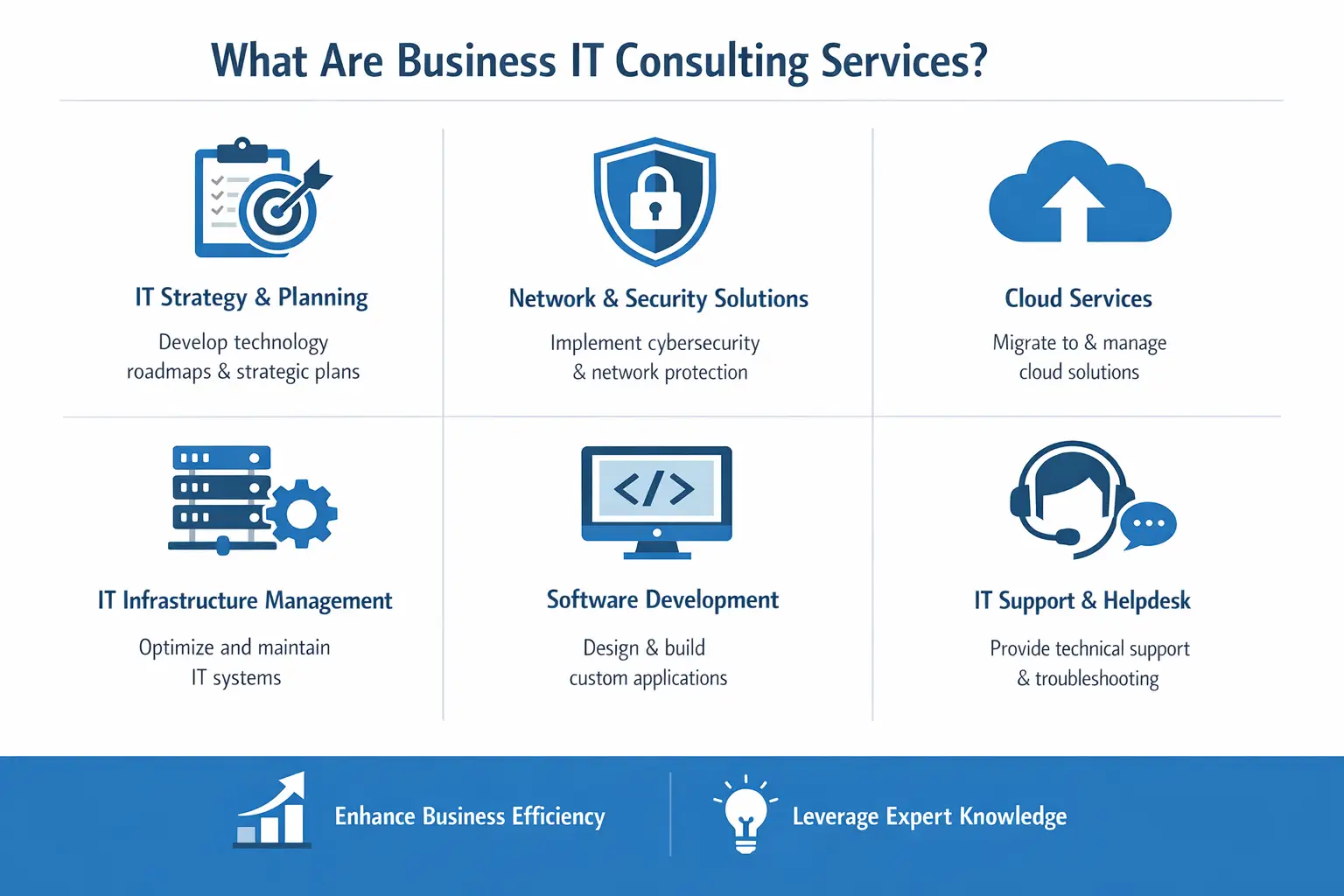
The main types of IT consulting services include IT strategy, IT architecture, IT infrastructure consulting, cloud consulting services (along with hybrid cloud consulting services), cybersecurity and IT risk management consulting, digital transformation consulting services, data and analytics, ERP and systems integration, AI and emerging technology, IT advisory services and vCIO, plus managed services.
Most Australian businesses use two or three of these at any one time. Rarely just one, and almost never all of them at once.
What IT Consulting & Services Actually Means?
Strip away the marketing fluff and consulting is two things welded together. Advice you can act on, and people willing to roll up their sleeves and help you act on it.
The dodgy operators stop at the slide deck. The decent ones stay until the lights actually come on. Big gap between those two.
Globally, the market sits north of USD 700 billion. Gartner and IDC both have Asia-Pacific growing quicker than most other regions in 2026. Plenty of room out there.
Some firms cover the full spectrum of technology consulting, ICT consulting, and business technology services under one roof. The team I work with at IT consulting services is built that way. Other firms stick to one slice and do it well. Both models work.
Picking the right shape of partner saves more money than haggling on day rates ever will.
At-a-Glance Comparison of Service Types
The whole landscape on one page. Use this as your map for the rest of the guide.
| Service Type |
Best Used For |
Typical Length |
Best For |
| IT Strategy |
3 to 5 year tech roadmap aligned to business goals |
4 to 8 weeks |
Boards, CFOs, CEOs |
| IT Architecture |
System and integration blueprint that scales |
6 to 12 weeks |
Growing mid-market |
| IT Infrastructure |
Network, server, storage, endpoint design |
Project based |
Multi-site operations |
| Cloud (incl. Hybrid) |
Migration, optimisation, FinOps, sovereignty |
3 to 12 months |
Any cloud adopter |
| Cybersecurity & Risk |
Essential Eight, APRA CPS 234, IRAP, SOCI |
Ongoing |
Regulated industries |
| Digital Transformation |
End-to-end operating model change |
12 to 36 months |
Legacy-heavy firms |
| Data & Analytics |
Migration, warehousing, dashboards, AI-ready data |
3 to 9 months |
Decision-heavy teams |
| ERP & Integration |
SAP, Oracle, Dynamics, NetSuite rollouts |
9 to 24 months |
Operations-heavy firms |
| AI & Emerging Tech |
Use case selection, governance, model rollout |
8 to 16 weeks per use case |
Early movers |
| Advisory / vCIO |
Fractional senior IT leadership on retainer |
Ongoing retainer |
SMEs without a CIO |
| Managed Services |
Day-to-day run of service desk, cloud, security ops |
Ongoing contract |
Lean internal teams |
IT Strategy Consulting Services
This is where I begin with almost every new client. IT strategy consulting services answer the bigger question of how your tech investment supports a three to five-year business plan.
Without that map, every decision turns into a coin flip. Boards hate coin flips.
A proper engagement delivers a roadmap, a budget you can defend, KPIs you can measure, and a stop-doing list. That last one is genuinely the most valuable. I’ve watched companies save seven figures by walking away from a doomed system early.
What it covers:
- Current-state audit and honest gap analysis
- Three to five year technology roadmap
- Capital and operating budget modelling
- Vendor consolidation and rationalisation plan
- KPIs tied to real business outcomes, not vanity metrics
When to engage: You’re scaling fast, integrating an acquisition, post-leadership change, or your board can’t agree on tech priorities.
IT Architecture Consulting
Architecture sits between strategy and execution. It’s the blueprint that tells you how your systems, data, and apps actually fit together so things don’t collapse when you double in size.
Skip it, and you end up with what I call a spaghetti stack. Twenty integrations, none documented, all held together by one bloke who left in 2022.
The good architects spend most of their time on diagrams and trade-off conversations. They’re already thinking about what happens when you swap out a core vendor or get hit with a fresh compliance rule. Cheap to do early. Brutal to retrofit later.
What it covers:
- Target-state architecture diagrams
- Integration patterns and API strategy
- Reference architectures for cloud, data, and security
- Trade-off analysis on vendor and platform choices
- Future-proofing against compliance and growth scenarios
When to engage: You’re planning a major modernisation, swapping a core vendor, or your environment has grown organically and needs rationalising.
IT Infrastructure Consulting
IT infrastructure consulting handles the plumbing. Networks, servers, storage, endpoints, the connections between the lot. When something falls over at 2 am, this is the team that figures out the why and rebuilds it properly.
The modern version is less about server rooms and more about architecture diagrams. Consultants model traffic, plan redundancy, and stress-test your environment against realistic peak loads.
Good infrastructure is invisible to your users. That’s the whole point of it.
What it covers:
- Network design and segmentation
- Server, storage, and virtualisation strategy
- Endpoint management and standard operating environment design
- Disaster recovery and business continuity planning
- Capacity planning for peak loads
When to engage: Headcount has doubled, latency complaints are climbing, your hardware refresh is looming, or you’ve simply outgrown the existing setup.
Cloud Consulting Services (with Hybrid Cloud)
Almost every conversation I have now touches cloud somewhere. Cloud consulting services help you decide what moves, what stays, and how to architect everything so the monthly bill doesn’t ruin Christmas.
AWS, Azure, and Google Cloud all behave differently. The right call depends on your workloads and the skills already sitting in your team.
Hybrid cloud consulting services have become especially busy lately. Plenty of Australian outfits keep certain data on-prem for sovereignty reasons while running everything else in the public cloud. Designing that split well is properly tricky work.
If you’re early in this journey, cloud infrastructure as a service is usually the most practical first step. FinOps, the discipline of controlling cloud spend, became its own consulting category after the cost blowouts of 2023 and 2024. A lot of CFOs got a fright.
What it covers:
- Cloud readiness assessment and total cost of ownership modelling
- Migration planning across AWS, Azure, and Google Cloud
- Hybrid and multi-cloud architecture design
- FinOps and ongoing cloud cost optimisation
- Cloud security posture management
When to engage: Cloud bills are growing faster than the business, you’re planning a migration, or compliance demands hybrid architecture.
Cybersecurity and IT Risk Management Consulting
The threats my clients face today look nothing like the ones from 2019. IT risk management consulting now covers ransomware, supply chain risk, insider threats, identity sprawl, and a growing pile of compliance obligations.
The ACSC Essential Eight has become the baseline most Australian organisations are pushed toward. Maturity Level Two is the practical working target for anyone holding customer data.
A proper engagement starts with an honest gap assessment. You can’t fix what you haven’t measured, and internal teams are nearly always too close to grade themselves fairly. The Privacy Act amendments, APRA CPS 234, IRAP, and the SOCI Act have lifted the bar across the board.
Security isn’t a project. It’s a posture. And the cost of getting it wrong is always higher than the cost of doing it properly the first time.
What it covers:
- ACSC Essential Eight maturity assessment and uplift
- APRA CPS 234, IRAP, ISO 27001, and SOCI Act alignment
- Identity and access management strategy
- Incident response playbooks and tabletop exercises
- Third-party and supply-chain risk reviews
When to engage: You handle regulated data, your board has asked for assurance, or you’re tendering for work that requires evidence of cyber maturity.
Digital Transformation Consulting Services
Digital transformation consulting services get tossed around as a buzzword. The real work changes how a business actually operates, not just what software it runs.
Automating a broken process gives you a faster broken process. The hard part is redesigning the workflow before anyone writes a line of code.
These programmes usually run twelve to thirty-six months and touch every department. Change management and culture matter as much as the tech. Honestly, the technology is the easiest bit of the whole job.
If a transformation doesn’t make life noticeably better for your customers or your staff, it isn’t transformation. It’s expensive housekeeping.
What it covers:
- Operating model and process redesign
- Customer and employee experience mapping
- Technology platform selection and rollout
- Change management and capability uplift
- Benefits realisation tracking
When to engage: Your industry is shifting under you, customer expectations have outgrown your tech, or a major platform end-of-life is forcing a rethink.
Data, Analytics, and Migration Consulting
Sitting right next to transformation is everything to do with data. Data visualization services turn raw numbers into something a leadership team can actually act on. Dashboards nobody opens are just expensive wallpaper.
Before you visualise anything, your data needs to live somewhere sensible. That’s where data migration services come in, shifting information from legacy systems into platforms built for modern analytics.
Botched migrations corrupt records and break trust for years. I’ve seen it happen twice in the last eighteen months.
Get the foundation right and analytics becomes a genuine edge. Get it wrong, and you’ll spend the next decade arguing about whose spreadsheet has the right number.
What it covers:
- Data warehouse and lakehouse design (Snowflake, Databricks, Microsoft Fabric)
- ETL and reverse-ETL pipeline build
- Power BI, Tableau, and Looker dashboard delivery
- Master data management and governance
- AI-ready data foundations
When to engage: Leadership can’t trust the reports, KPIs take days to assemble, or you’re preparing the business for AI workloads.
ERP and Systems Integration Consulting
ERP work handles the central nervous system of bigger businesses. Finance, inventory, HR, and procurement all running through one platform. SAP S/4HANA, Oracle Fusion, NetSuite, or Microsoft Dynamics 365 are the usual suspects.
Getting the rollout right is one of the highest-stakes projects a mid-sized business will ever attempt. Fail one of these and the cleanup takes years.
Systems integration consulting sits next to it, making sure your tools actually talk to each other. Most of my clients run twenty or thirty different applications. The value lives in the connections between them.
What it covers:
- ERP package selection and vendor evaluation
- Implementation partner oversight
- Systems integration via MuleSoft, Boomi, or native APIs
- Data migration into the new platform
- Post-go-live optimisation and hypercare
When to engage: You’re outgrowing QuickBooks or MYOB, planning a finance transformation, or living with a Frankenstein stack of point solutions.
AI and Emerging Technology Consulting
This is the fastest-moving category I’ve seen in three decades. AI consulting now spans model selection, governance frameworks, agentic workflows, prompt design, and staff training.
The hype is loud. The practical wins are real, but only when the scope is honest.
Most businesses don’t need a custom large language model. They need a frank conversation about which workflows actually benefit from automation and which ones don’t. A good AI consultant tells you what to skip just as often as what to build.
And quietly, in the background, the smart ones are already thinking about quantum-safe cryptography for anything sensitive that has to last past 2030.
What it covers:
- AI use-case identification and prioritisation
- Model selection across OpenAI, Anthropic, Google, and open-source
- AI governance, risk, and ethics frameworks
- Agentic workflow design and rollout
- Quantum-safe cryptography readiness for long-life data
When to engage: Your competitors are talking about AI in earnings calls, your staff are using ChatGPT unofficially, or you need a sensible governance position before the regulator asks.
IT Advisory Services and vCIO Engagements
IT advisory services sit a level above project work. Think of it as a senior technologist on retainer who you ring when a vendor pitch lands on your desk, or when a board paper needs a second set of eyes.
The good ones quietly save you from decisions you didn’t even realise were bad.
A virtual CIO, or vCIO, extends that into a fractional leadership role. Works particularly well for mid-sized businesses that can’t justify a full-time CIO but still need someone senior pulling the strings. You get the strategic input without the salary load.
What it covers:
- Monthly or quarterly executive technology reviews
- Vendor and contract negotiation support
- Board reporting and risk papers
- Roadmap governance and benefits tracking
- Cross-pollinated thinking from every other client they serve
When to engage: You don’t need (or can’t justify) a full-time CIO but still need senior IT leadership at the table.
Managed Services and Co-Sourcing
A lot of consulting now bleeds into ongoing managed services. Instead of handing over a report and disappearing, the partner runs part of your environment day to day.
Service desk, cloud monitoring, security operations, and backups are the usual candidates.
Co-sourcing splits the difference between fully in-house and fully outsourced. Your team keeps doing what they’re best at. The partner fills the gaps. Works beautifully for businesses with strong institutional knowledge but limited depth in niche areas like cloud security or platform engineering.
What it covers:
- Service desk and end-user support
- Cloud monitoring and platform engineering
- Managed security operations (SOC, SIEM, EDR)
- Backup, disaster recovery, and patch management
- Selective co-sourcing of niche skill gaps
When to engage: You want predictable spend, your internal team is burning out, or you need 24/7 cover without hiring 24/7 headcount.
What’s Changed in IT Consulting in 2026
The fundamentals haven’t moved much. The priorities certainly have.
Here’s what’s actually different in the engagements I’m running this year, compared to even eighteen months ago.
- AI roadmapping has overtaken cloud migration as the most-requested strategy piece.
- FinOps has gone from optional to essential after the post-pandemic cloud cost blowouts.
- Cyber resilience (how fast you recover) now sits beside cyber security (how hard you are to break) on every board agenda.
- Data sovereignty conversations have intensified, pushing more Australian businesses toward hybrid cloud consulting services.
- Quantum-safe cryptography planning is showing up in financial services and government tenders.
- The Essential Eight Maturity Level Two has become the practical floor for any business handling sensitive data.
IT Consulting vs Managed Services
These two get confused all the time. Here’s the cleanest way to tell them apart.
| Dimension |
IT Consulting |
Managed Services |
| Purpose |
Solve a defined problem or plan a change |
Run technology operations day to day |
| Engagement Shape |
Project, retainer, or sprint |
Monthly recurring contract |
| Output |
Strategy, design, implementation, knowledge transfer |
Uptime, response times, ongoing improvement |
| When You Need It |
Change, growth, risk events, modernisation |
Steady state, after-hours cover, lean team |
| Pricing |
Day rates or fixed-price scope |
Per-user, per-device, or flat monthly fee |
| Typical Length |
4 weeks to 24 months |
12 to 36 month contracts |
Most mature businesses use both. Consultants lead the change. Managed teams keep the lights on between projects.
Typical Costs and Engagement Lengths in Australia
Rates vary by location, scarcity of skill, and your industry. These ranges reflect what I see in the Sydney, Melbourne, and Brisbane markets in 2026. Perth and Canberra trend slightly higher for security and government work.
| Engagement Type |
Day Rate (AUD) |
Typical Project Spend |
Length |
| Generalist IT advisory |
$1,200 to $1,800 |
$15k to $60k |
4 to 8 wks |
| IT strategy consulting |
$1,800 to $2,800 |
$25k to $120k |
6 to 12 wks |
| Cloud consulting services |
$1,800 to $3,000 |
$40k to $400k |
3 to 12 mo |
| Cybersecurity consulting |
$2,000 to $3,500 |
$25k to $300k+ |
Varies |
| AI and emerging tech |
$2,200 to $3,500 |
$30k to $250k |
8 to 16 wks |
| vCIO retainer |
n/a |
$3k to $12k per month |
Ongoing |
| ERP implementation oversight |
$1,800 to $2,800 |
$80k to $1m+ |
9 to 24 mo |
How to Choose the Right IT Consulting Partner
The market is noisy, and picking the right partner is genuinely hard. I tell every prospect to ask three questions before signing anything.
What does success actually look like? Who specifically does the work? What happens when something goes pear-shaped?
Look for industry experience, real platform certifications, and references from clients whose projects went badly. How a firm handles a stuff-up tells you ten times more than any glossy case study. Anyone can deliver when the wind is at their back.
Local presence still counts too, particularly for compliance work tied to Australian regulators. Same time zone, same accent, and someone you can actually meet for coffee. Still matters more than people admit.
Green Flags Worth Paying For
- Named senior people on your account, not just sales leads
- Australian compliance experience (Essential Eight, APRA, IRAP, SOCI)
- Clear written scope with measurable acceptance criteria
- References they let you call without supervision
- Willingness to walk away from work that doesn’t fit
Red Flags to Walk Away From
- Vague scopes that bill you by the hour without a ceiling
- Junior staff doing work the senior person pitched
- No methodology, just promises about being agile
- Reluctance to share references or case studies
- Pressure to sign before due diligence is finished
Where to Go from Here
If you’ve got this far, you probably already know which type of consulting your business actually needs.
The harder part is finding a partner who’ll be straight with you about what’s achievable and what isn’t. After all these years in the trade, I find most problems shrink the moment you talk them through with someone who’s seen them before.
If you want a second opinion on a proposal sitting on your desk, or just a no-pressure chat about where to start, Contact Us, and we’ll work through it together. No slide deck required.
Frequently Asked Questions
1. What’s the difference between IT consulting and managed services?
Consulting is project-based strategic work. Managed services run your operations day to day. Most businesses use both, with consultants leading change and the managed team keeping the lights on.
2. How much do IT consulting services cost in Australia?
Day rates run from around AUD 1,200 for generalist work up to AUD 3,500 or more for specialist security, cloud architecture, or AI consultants. Fixed-price engagements are common for well-defined projects. vCIO retainers usually sit between AUD 3,000 and AUD 12,000 per month.
3. Which type of IT consulting should a small business hire first?
A vCIO or IT strategy engagement is nearly always the right opening move. It tells you what specific technical work to commission next, and stops you spending money on tools you don’t yet need.
4. How long does a typical IT consulting engagement run?
Strategy and discovery work usually takes four to eight weeks. Implementation projects span three to eighteen months depending on scope. Advisory retainers and vCIO arrangements often run for years.
5. Do I need a consultant who specialises in my industry?
Industry depth matters in regulated sectors like finance, healthcare, and government. For most other businesses, a strong generalist with proven Australian compliance experience beats a narrow specialist.
6. Is IT consulting actually worth the money?
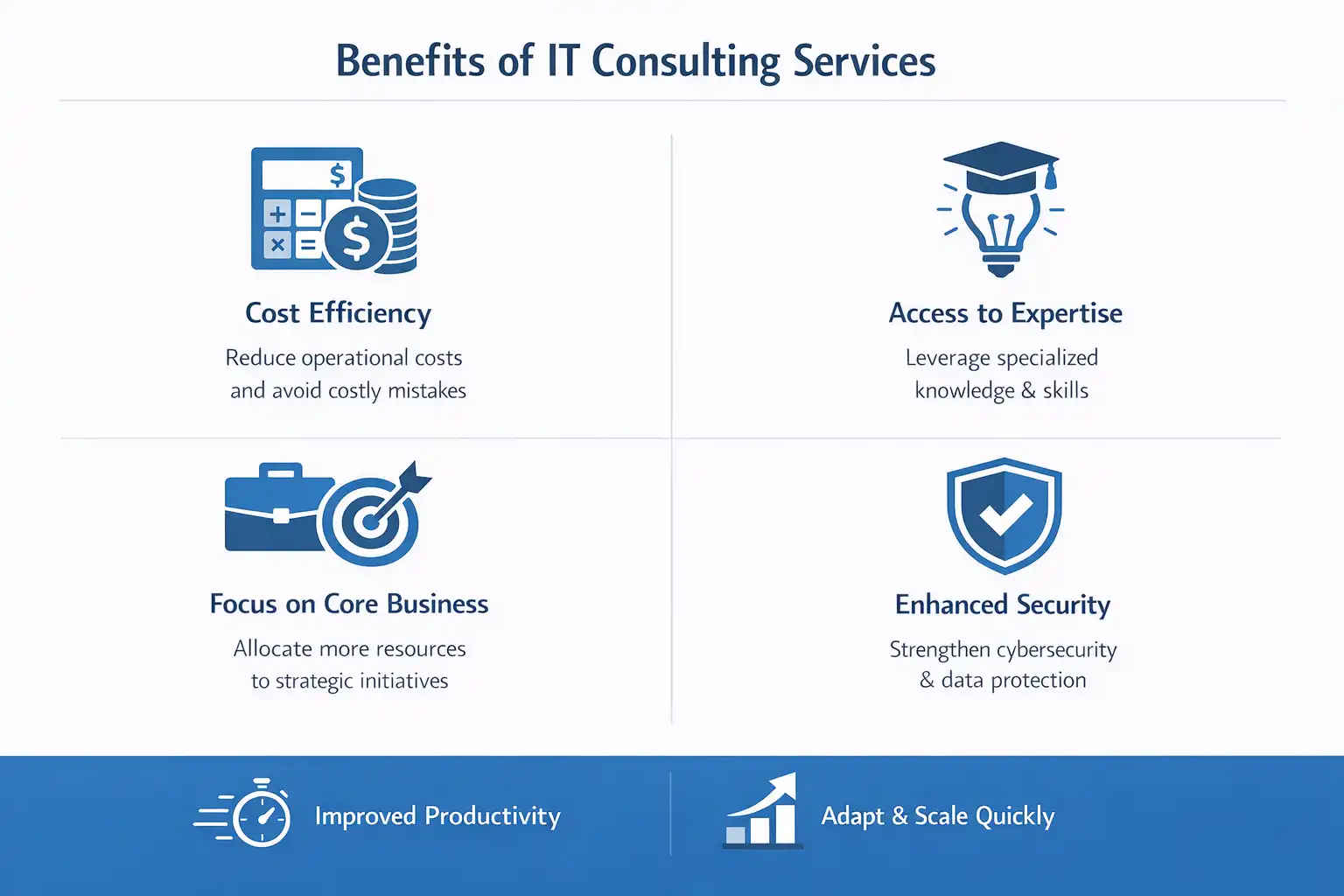
It is when you scope it around a measurable outcome. The wins come from avoided mistakes, faster decisions, and fewer wrong purchases. The losses come from vague briefs that drift for months.
7. What questions should I ask before hiring an IT consultant?
Ask who specifically does the work, what success looks like in writing, how change is governed, and how the firm has handled a project that went wrong. That last answer is usually the most telling one.
8. Can I use multiple types of IT consulting at the same time?
Yes, and most mid-market and enterprise clients do. A common stack is a vCIO advisor on retainer, a strategy partner for the big roadmap, and specialist consultants for cloud, security, and data as needed.